SAAKSHI — the witness for every rupee
A read-only forensic layer over India's public spending data, plus a toll-free voice line so any citizen can ask what was spent in their village. Hackathon prototype for TechGig × Optum's Inclusive Innovation for Bharat.
The problem
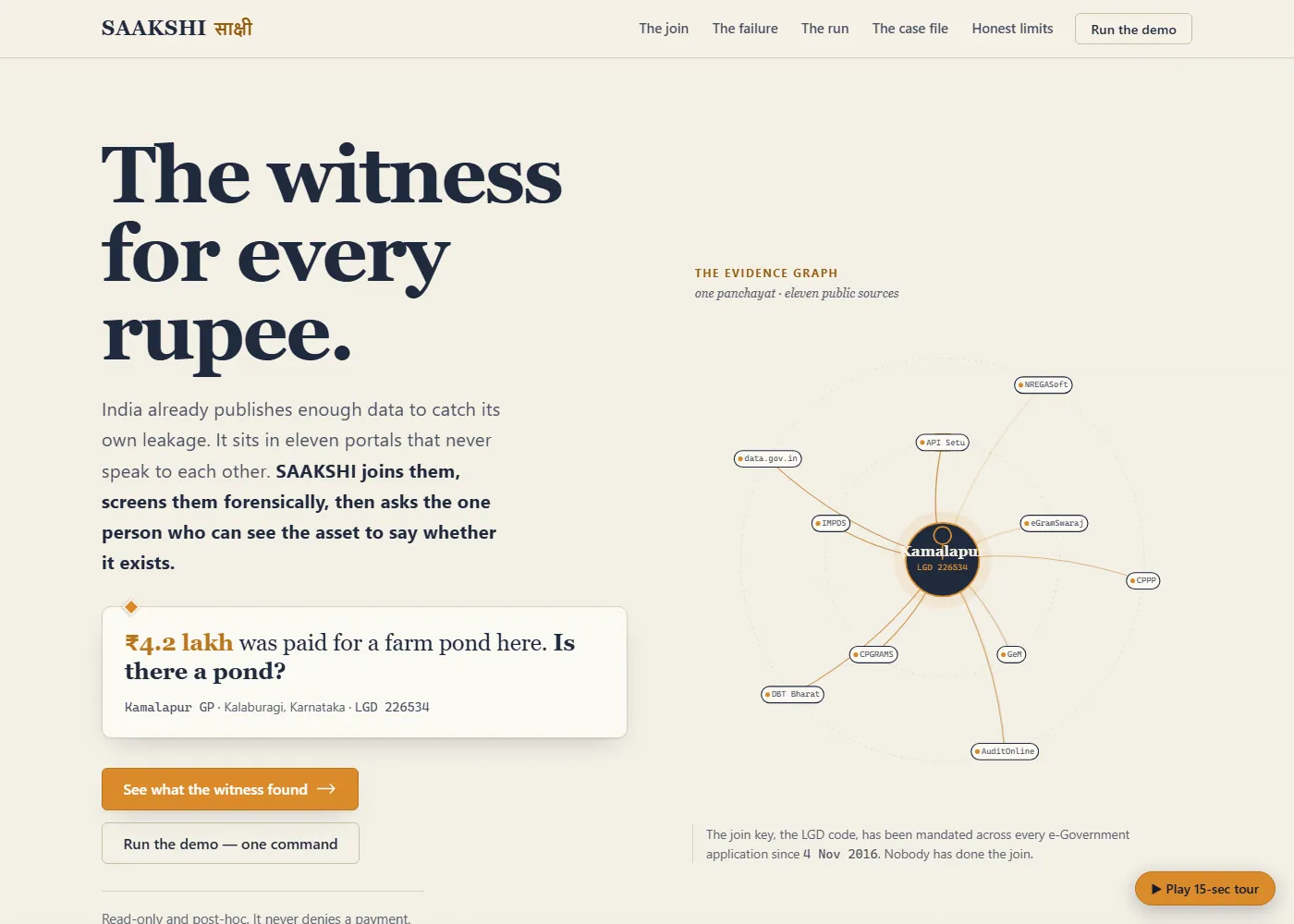
India already publishes enough data to catch its own leakage. Works, payments, tenders, audit observations, grievances and transfers sit on eleven separate government portals that never talk to each other — even though every one of them has carried the same location key (the LGD code) since 2016. Nobody has done the join.
The consequence shows up in the state's own dashboards: 62,745 audit observations recorded on AuditOnline nationally, and zero Action Taken Reports filed against them. Social audits covered 38.58 % of MGNREGA works in FY2025-26 and still surfaced 61,347 cases of misappropriation. The country is not failing to find corruption because it is hard to find. It is failing because there are not enough auditors, and the findings that do surface go nowhere.
And the person best placed to check — a villager who can walk to the "farm pond" and see whether it exists — usually has no smartphone (only 48.4 % of rural women 15+ own one) and doesn't read English.
What SAAKSHI is
SAAKSHI (साक्षी, "the witness") is a read-only forensic and accountability layer over the data the government already publishes, joined on the LGD code, with a toll-free phone number that lets any citizen interrogate it in their own language. It surfaces evidenced, time-bound questions about welfare spending — never verdicts — and then asks the one citizen who can see the asset to verify it.
Two rules shape everything: it is read-only and post-hoc — it never denies a payment, blocks a job card or gates a ration, because a false positive should cost an official an explanation and never a citizen her rice; and every honest limit ships with the capability.
How it works
Six named layers, each doing one job:
- KOSH (कोष, the treasury) joins the eleven portals into one ledger graph per panchayat.
- CHITRAGUPTA (the divine accountant) runs four independent detectors — the same four checks the
auditor-general did by hand: a perceptual hash to catch reused completion photos; a date comparison
to catch payments made after a work was "completed"; a
GROUP BYto catch contracts split to dodge the tender threshold and vendors who keep winning as the only bidder; and a device-itinerary check for one phone geo-tagging attendance at eight sites in an hour. The four signals are never fused into a single "corruption score." - NAAM-MILAN resolves Indic names across sources with calibrated confidence, never a hard match.
- VAANI (voice) is the phone line: an intent router over roughly forty vetted, parameterised queries. A language model never writes a query — anything a citizen hears is deterministic.
- PRAMAAN (proof) takes anonymous citizen reports — "there is no pond here" — bound cryptographically so they can't be traced to a person, and turns corroborated ones into training labels. That closes the gap that blocks every procurement-fraud model: there are no confirmed positives to learn from.
- GHADI (the clock) opens an accountability case file: an auto-drafted Right to Information request, a grievance filing, a Gram Sabha agenda item, and a public countdown on the statutory deadlines — with a "what we do not know" section in every file.
The prototype
The repository ships a runnable prototype that a judge can clone and run in one command — Python standard library only, no installs, no network, no API keys. It reconstructs the March 2026 CAG Karnataka MGNREGA audit as a synthetic dataset and shows the detectors independently re-deriving each published finding:
| The auditors found, by hand | SAAKSHI's detector | Result |
|---|---|---|
| Identical photos reused across construction stages | perceptual hash | a completion photo reused across two works 61 km apart, in different districts |
| Payments for stages on already-completed houses | date comparison | 462 instances · ₹1.19 crore — matches the published number exactly |
| A check dam split in two to dodge tendering | threshold-split check | ₹2.4 L + ₹2.9 L = ₹5.3 L, same panchayat and vendor, 11 days apart |
| (never published in India) | single-bid rate | a national single-bid rate of 14 %; one vendor won 11 of its tenders as the sole bidder |
| — | device itinerary | one phone geo-tagging attendance at 8 sites in under an hour |
All five checks are asserted in the demo and in a ten-test suite. The case file it produces for the reference work — a ₹4.2 lakh farm pond in Kamalapur, Karnataka — lists four signals with separate confidences, then says plainly what it does not know, and ends with a drafted RTI request.
What is real and what is not, stated as the repository states it: the dataset is a synthetic reconstruction of published audit findings, not live-scraped portal data; the satellite and citizen-report signals in the offline demo are simulated inputs; the toll-free number is illustrative.
Context
Built for TechGig × Optum — Inclusive Innovation for Bharat, Theme 05 (GovTech & Public Service Delivery). The submission includes an application, an 18-slide deck, a demo video, a pitch website, the runnable prototype and a research dossier where every headline number carries a reliability marker. The repository is private while the competition runs; the banner is the pitch website. MIT licence.
Next project
tinySafetyNet