Projects
Zombies-learning-progression-PGGAN
Creating zombies similar to humans — PGGAN for temporal brain MRI imaging.
Repository ↗January 2026
✓ 7 claims checked against the source repository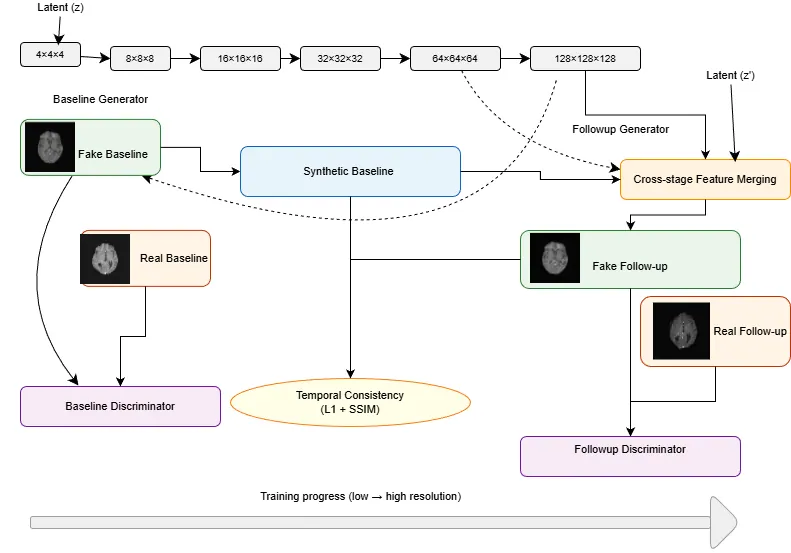
Overview
An end-to-end pipeline for augmenting longitudinal brain MRI data with a Two-Generator Progressive GAN (PGGAN). The GAN generates anatomically consistent baseline and follow-up MRI pairs, and this synthetic data is used to augment limited real datasets for two downstream tasks: 3D tumor segmentation and RANO classification.
Research paper (Overleaf): read-only link
What it does
The pipeline runs in five stages:
- Train the GAN on preprocessed real MRI volumes (
CACHED128). - Generate synthetic data: baseline–follow-up pairs written to
generated1070as.npzfiles (each containing baseline and follow-up T1ce). - Train a 3D segmentation model (CoTrSeg / nnU-Net / DynUNet) on real MRI data.
- Run inference on the synthetic images with the trained segmentation model (
visualisation128aug). - Train a RANO classifier with XGBoost on real plus synthetic images, their segmentation masks and radiomics features, using SMOTE to handle class imbalance.
How it's built
- Dual generators:
G_Bgenerates a baseline MRI from a latent vectorz;G_Fgenerates the follow-up MRI fromzplus baseline features, conditioned at all scales. - Dual discriminators:
D_Bfor baseline andD_Ffor follow-up, trained with WGAN-GP for stability. - Loss: adversarial + λ₁·L1 + λ₂·SSIM, chosen to enforce anatomical consistency and temporal realism.
- Volumes: all processing is on 128 × 128 × 128 3D volumes.
- Data format: each real sample is a 10-channel
.npzof shape(10, 128, 128, 128): baseline T1/T1ce/T2/FLAIR (channels 0–3), follow-up T1/T1ce/T2/FLAIR (4–7), and baseline/follow-up masks (8–9) with labels 0 = background, 1 = edema, 2 = tumor. The T1ce channels are the ones used by the GAN and segmentation. - Code layout:
pggan/(config, dataset, networks, train, generate),train_cotrseg.py/model_cotrseg.pyfor segmentation, andtrain_classifier_radiomics.pyfor the RANO classifier.
Results
Quantitative results are not given in the README; they are deferred to the linked paper.
Next project
BrandDiffusion